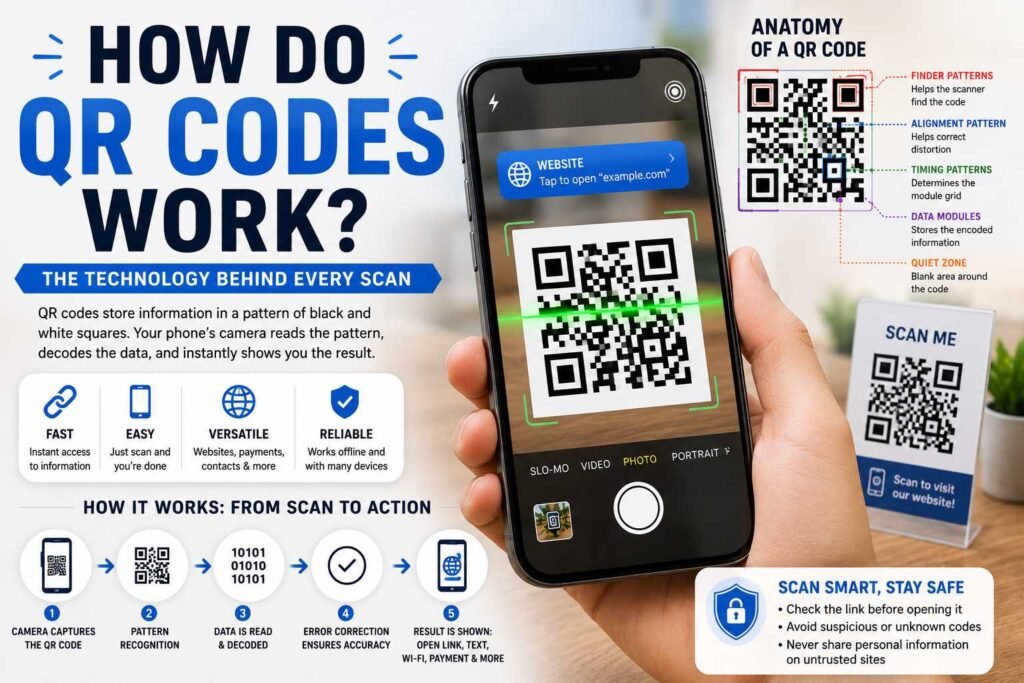
People often ask how do QR codes work because these two-dimensional patterns are everywhere. From restaurant menus and product packages to event tickets and mobile payment screens, how do QR codes work is fundamental to modern digital communication. While a QR symbol appears to be a random assortment of black and white modules, it encodes data that optical sensors and smartphone cameras decode instantly.
Understanding how do QR codes work requires looking at how data is encoded into spatial grids, processed by visual algorithms, and safeguarded by error correction systems. This guide breaks down the underlying technology, structural anatomy, scanning mechanics, and security protocols behind modern QR code systems.
What Is a QR Code?
QR stands for Quick Response. Invented in 1994 by Masahiro Hara at Denso Wave to track automotive parts, a QR code is a high-density, matrix barcode capable of encoding data vertically and horizontally.
+-------------------------------------------------------------------------+
|                      MATRIX VS. LINEAR BARCODES                         |
+-------------------------------------------------------------------------+
|  TRADITIONAL BARCODE (1D)               QR CODE (2D)                    |
|  • Encodes horizontally only            • Encodes horizontally & vertically |
|  • Storage: ~20 numeric characters      • Storage: Up to 7,089 numbers   |
|  • Requires line-of-sight laser scanner • Scannable from any 360° angle   |
+-------------------------------------------------------------------------+
Unlike traditional linear barcodes that rely solely on horizontal line widths, QR codes utilize a two-dimensional grid of modules (square pixels) to store substantially larger amounts of information.
How Do QR Codes Work Behind the Scenes?
At a fundamental level, how do QR codes work comes down to converting alphanumeric data into binary code ($0$s and $1$s), which is then visually mapped onto a grid matrix.
+-------------------------------------------------------------------------+
|                          THE ENCODING PIPELINE                          |
+-------------------------------------------------------------------------+
|  [Data Input] ──> [Binary Encoding] ──> [Error Correction Encoding]     |
|                                                      │                  |
|  [Result/Action] <── [Decoded Data] <── [Grid Mapping & Masking]        |
+-------------------------------------------------------------------------+
When a user points a camera at a code, the software performs a multi-step decoding sequence:
- Optical Capture: The camera lens acquires the image matrix.
- Binarization: The image processor converts the color/grayscale capture into a pure black-and-white grid.
- Pattern Localization: Software isolates the matrix boundaries using structural orientation markers.
- Data Extraction & Reed-Solomon Correction: The grid evaluates module values, corrects missing data bits, and retrieves the embedded text or URL.
The Structural Anatomy of a QR Code
A QR matrix is strictly organized into functional components to ensure consistent reading across different devices and angles.
+-------------------------------------------------------------------------+
|                       QR CODE STRUCTURAL MAP                            |
+-------------------------------------------------------------------------+
|  [FINDER PATTERN]  [Timing Pattern]  [FINDER PATTERN]                   |
|   (Top-Left)                          (Top-Right)                       |
|                                                                         |
|   Data Modules        [ALIGNMENT]     Data Modules                      |
|                       PATTERN                                           |
|                                                                         |
|  [FINDER PATTERN]  Data Modules      [QUIET ZONE (Outer Margin)]        |
|   (Bottom-Left)                                                         |
+-------------------------------------------------------------------------+
- Finder Patterns: The three large concentric squares located at the top-left, top-right, and bottom-left corners. They allow the software to instantly locate the code and detect its rotation angle.
- Alignment Patterns: Smaller concentric squares inside larger matrix versions that normalize perspective distortion when a code is scanned on a curved or tilted surface.
- Timing Patterns: Alternating dark and light modules running horizontally and vertically between finder patterns that define the grid matrix dimensions.
- Data & Error Correction Modules: Also, the remaining internal grid space stores binary payload bits alongside mathematical redundancy data.
- Quiet Zone: A mandatory blank margin surrounding the entire matrix, ensuring the camera distinguishes the QR code from neighboring visual graphics.
How Smartphone Software Reads and Decodes Data
Understanding how do QR codes work on mobile devices involves examining the real-time software pipeline:
+-------------------------------------------------------------------------+
|                      SMARTPHONE SCANNING PROCESS                        |
+-------------------------------------------------------------------------+
|  1. CAMERA CAPTURE   ──> Sensor grabs live optical feed                 |
|  2. PATTERN RECOG.   ──> Software detects the 3 Finder Patterns         |
|  3. ORIENTATION      ──> Image matrix is digitally aligned & rotated    |
|  4. GRID MAPPING     ──> Software reads bit-array of dark & light modules|
|  5. DECODING         ──> Reed-Solomon algorithm recovers payload        |
|  6. ACTION PROMPT    ──> System prompts user action (URL, Wi-Fi, etc.) |
+-------------------------------------------------------------------------+
Static vs. Dynamic QR Codes
| Feature | Static QR Codes | Dynamic QR Codes |
| Data Storage | Encodes destination data directly into the matrix | Encodes a short redirect URL |
| Editability | Cannot be modified after creation | Destination URL can be updated anytime |
| Matrix Density | Increases with longer URLs or larger payloads | Remains low and simple |
| Analytics | Scans cannot be tracked | Tracks scan counts, locations, and OS data |
| Use Cases | Wi-Fi passwords, vCards, fixed text | Marketing campaigns, digital restaurant menus |
Error Correction Levels: Why Damaged Codes Still Work
A core component of how do QR codes work reliably in real-world environments is built-in fault tolerance. QR technology utilizes Reed-Solomon Error Correction, allowing codes to remain scannable even when partially torn, smudged, or covered by a central company logo.
| Error Level | Recovery Capacity | Ideal Usage Scenario |
| Level L | ~7% of data restored | Clean digital displays, simple unprinted codes |
| Level M | ~15% of data restored | Standard marketing collateral, crisp print media |
| Level Q | ~25% of data restored | High-wear industrial environments |
| Level H | ~30% of data restored | Codes featuring custom central logos or artistic edits |
Security Risks & Best Practices
While the technology underlying how do QR codes work is inherently secure, the underlying payload can be manipulated by malicious actors.
+-------------------------------------------------------------------------+
|                         QR PHISHING (QUISHING)                          |
+-------------------------------------------------------------------------+
|  [Physical Sticker Overlay] ──> [Malicious URL Payload] ──> [Credential |
|                                                               Theft]    |
+-------------------------------------------------------------------------+
- Inspect Physical Stickers: Scammers sometimes place malicious QR code stickers over legitimate public codes (e.g., parking meters).
- Verify URL Banners: Always preview the destination domain before tapping the pop-up notification on your smartphone screen.
- Avoid Unsolicited Downloads: Never approve automatic application installer downloads (APK files) triggered directly by a scan.
Frequently Asked Questions
How do QR codes work when scanned from an angle?
The three primary finder patterns combined with interior alignment markers allow software to apply geometric transformations, mathematically flattening tilted images before reading the grid.
How do QR codes work with color and custom designs?
As long as there is high contrast between the modules and the background (such as dark modules on a light background), color variations do not interfere with binary optical decoding.
How do QR codes work to connect devices to Wi-Fi networks?
The QR code encodes a specific structured string containing the SSID, encryption type (e.g., WPA/WPA2), and network password, which mobile operating systems process directly to establish a connection.
Conclusion:
Mastering how do QR codes work reveals a sophisticated balance of optical design, binary encoding, and algebraic error correction—creating a fast, dependable link between physical items and digital content.