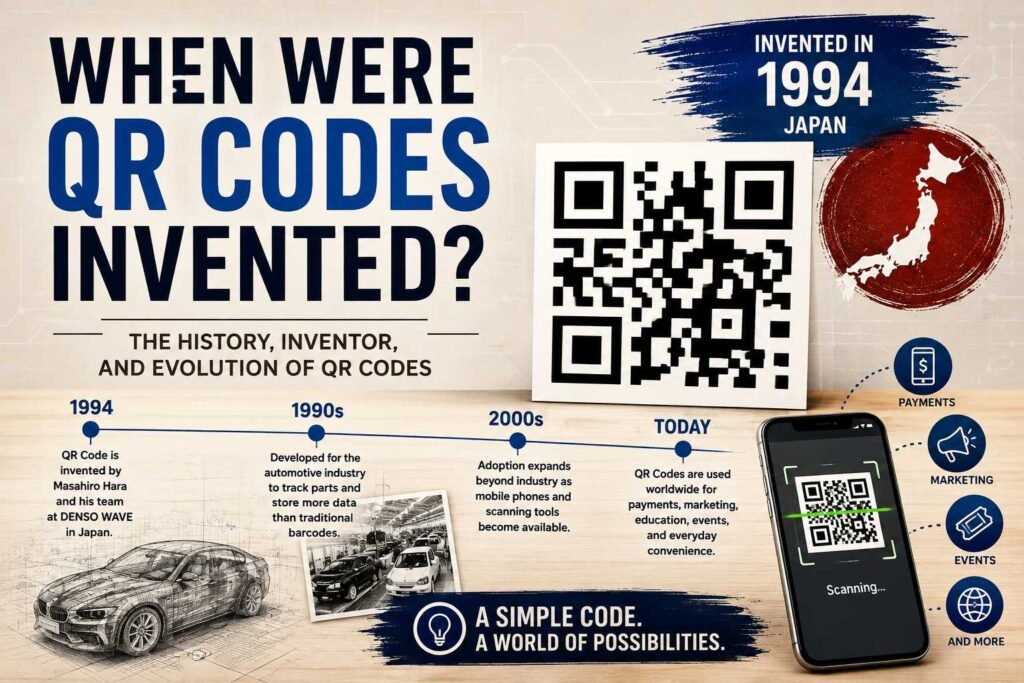
If you have ever wondered when QR codes were invented, the answer goes back to 1994. Japanese engineer Masahiro Hara and his team at DENSO WAVE developed the Quick Response (QR) code to solve a growing problem in the automotive manufacturing industry. What began as an industrial tracking tool eventually evolved into one of the world’s most recognizable methods for sharing digital information instantly.
Today, QR codes appear virtually everywhere:
- Hospitality & Retail: Restaurant menus, ordering systems, and product packaging
- Marketing & Business: Advertisements, business cards, websites, and promotional signage
- Services & Ticketing: Event access, payment terminals, and educational resources
A modern smartphone camera can scan a code in milliseconds—immediately opening a web link, displaying detailed information, or initiating a secure payment. Though the technology feels distinctly modern, QR codes have been in continuous use for over three decades.
The Origin Story
When Were QR Codes Invented?
The original QR code was created in 1994 in Japan by a development team at DENSO (then a division of DENSO WAVE), a major automotive components manufacturer.
At the time, the automotive manufacturing sector relied heavily on standard one-dimensional (1D) barcodes to track parts. However, conventional barcodes presented critical operational bottlenecks:
- Limited Capacity: Standard 1D barcodes could only hold around 20 alphanumeric characters.
- Multiple Barcode Burden: Workers often had to scan up to 8 to 10 separate barcodes on a single component box to retrieve complete manufacturing data.
- Scanning Delays: Production lines were slowed down by alignment issues and frequent scanning failures.
To eliminate these bottlenecks, DENSO tasked Masahiro Hara with engineering a next-generation code that could hold vastly more data while remaining fast and reliable to scan.
The Engineering Behind the Innovation
Who Invented the QR Code?
Masahiro Hara is widely recognized as the primary inventor of the QR code. While analyzing the limitations of 1D systems, Hara noticed that workers wasted significant time aligning optical scanners at precise angles relative to the printed lines.
       ┌─────────────────────────┐
       │  [■■■]           [■■■]  │  ◄── Corner Position Patterns
       │  [■■■]           [■■■]  │      (Enable 360° Omnidirectional Scanning)
       │                         │
       │                         │
       │  [■■■]                  │
       │  [■■■]                  │
       └─────────────────────────┘
To solve this, Hara designed the iconic three-corner square pattern (position detection markers). These outer squares allow optical sensors to determine the exact orientation and angle of the code instantly, enabling seamless 360° scanning regardless of how the code is positioned.
Why Were They Called “Quick Response”?
The primary objective of the DENSO team was speed. The name Quick Response reflects the ultimate goal: creating a two-dimensional matrix code that could be read at extreme speeds without sacrificing accuracy.
QR Codes vs. Traditional Barcodes
| Feature | 1D Barcodes | 2D QR Codes |
| Data Structure | One-dimensional (horizontal lines) | Two-dimensional (horizontal & vertical matrix) |
| Data Capacity | ~20 alphanumeric characters | Up to 7,089 numeric or 4,296 alphanumeric characters |
| Scanning Angle | Strict alignment required | 360° omnidirectional scanning |
| Damage Resistance | Fails if line pattern is damaged | Built-in Reed-Solomon error correction |
| Primary Use Cases | Retail UPC checkout, simple inventory | URLs, payments, rich data, multi-industry tracking |
Key Technical Advantages
- High Storage Capacity: By encoding data both horizontally and vertically across a grid of black-and-white modules, QR codes pack thousands of characters into a compact square.
- Built-In Error Correction: Utilizing Reed-Solomon error correction algorithms, QR codes remain fully readable even if up to 30% of the code is obscured, scratched, or damaged.
  Error Correction Levels:
  ├── Level L  : ~7%  data recovery
  ├── Level M  : ~15% data recovery
  ├── Level Q  : ~25% data recovery
  └── Level H  : ~30% data recovery
- Versatile Data Encoding: QR codes support multiple data types, including numeric, alphanumeric, byte/binary, and Kanji characters.
Evolution: From Factory Floors to Global Adoption
1. Open Patent and Industrial Adoption (1994–2000s)
Although DENSO WAVE held the patent rights to the QR code technology, the company made a strategic decision not to exercise its patent rights. By releasing the specification openly and license-free, DENSO allowed global industries to adopt and build upon the technology without cost barriers.
2. The Smartphone Era (2010s)
In its early consumer years, scanning a QR code required downloading third-party mobile applications, which created friction for adoption. A major turning point occurred around 2017 when major mobile operating systems (iOS and Android) integrated native QR scanning directly into standard smartphone camera apps.
3. The Pandemic Acceleration (2020–Present)
The COVID-19 pandemic drastically shifted consumer behavior toward touchless interactions. Organizations worldwide deployed QR codes for:
- Contactless digital menus in restaurants
- Touch-free check-ins and registration
- Mobile payments and digital ticketing
Modern Applications & Architecture
Common Consumer & Industrial Uses
- Contactless Payments: Widely used across global payment platforms (e.g., Alipay, WeChat Pay, UPI, and Venmo).
- Supply Chain & Logistics: Real-time package tracking and automated warehouse management.
- Product Transparency: Packaging links directly to user manuals, ingredients, or authentication verification.
Static vs. Dynamic QR Codes
Static QR Code
Encodes data directly into the matrix pattern. Once generated, the target content (e.g., a fixed text string or plain website link) cannot be edited or tracked.
Dynamic QR Code
Encodes a short redirection URL that points to the target destination. The destination web page can be modified at any time without reprinting the physical code, enabling scan analytics and dynamic content management.
Frequently Asked Questions
When were QR codes invented?
QR codes were invented in 1994 by Japanese engineer Masahiro Hara and his team at DENSO WAVE to track automotive components during manufacturing.
Who invented the QR code?
Masahiro Hara led the development team at DENSO WAVE that engineered the QR code architecture.
What does “QR” stand for?
QR stands for Quick Response, referring to the design intention of enabling high-speed scanning and data retrieval.
Are QR codes safe to scan?
QR codes themselves are safe static data structures. However, malicious actors can attempt “QRishing” (QR code phishing) by placing malicious stickers over legitimate codes. Always verify the destination URL shown by your phone’s camera before proceeding to a web page.
Here is the conclusion section from the article, cleaned up and fully formatted with proper typography, smooth transitions, and clean punctuation:
Conclusion
The answer to when QR codes were invented takes us back to 1994 in Japan, when DENSO WAVE developed the technology to solve a critical manufacturing bottleneck. What started as an industrial method for tracking automotive parts eventually transformed into a ubiquitous global tool used for digital menus, contactless payments, marketing campaigns, event ticketing, and identity authentication.
The enduring success of the QR code stems from its unmatched blend of simplicity, speed, and technical capability. By encoding data in two dimensions, enabling 360-degree omnidirectional scanning, and integrating robust Reed-Solomon error correction, QR codes offer reliability that traditional one-dimensional barcodes simply cannot match.
Smartphones ultimately bridged the gap between industrial utility and everyday consumer life. More than three decades after their invention, QR codes continue to serve as one of the most efficient, cost-effective, and versatile bridges between physical reality and digital experiences.